

A grain dryer lowers the moisture of harvested grain to a safe storage level, so it can be stored without spoiling and sold without moisture shrink.
A short, wet harvest is the norm in much of Canada. When the weather turns, your drying capacity decides how much crop you bring in on time and how much quality you keep.


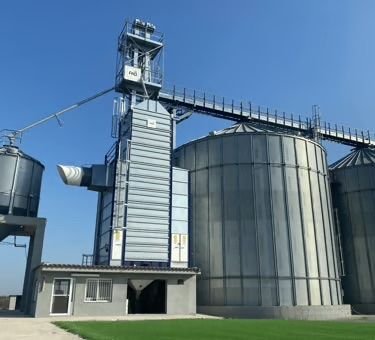
Heat, airflow and time: how a dryer removes water
Every grain dryer does the same thing: it warms air so it can hold more water, pushes it through the grain, and exhausts the moist air. What changes between designs is how grain and air meet. In cross-flow dryers the air crosses a column of grain; in mixed-flow dryers the grain zigzags through alternating air ducts for more even drying; in-bin systems dry slowly in the storage bin itself.
The cooling section matters as much as the heat. Grain that leaves the dryer warm keeps losing moisture and can sweat in the bin. Many operations use dryeration: grain leaves the dryer hot and slightly above target, tempers in a bin for several hours, then is cooled with aeration. It saves fuel, increases capacity and reduces stress cracks.
What you gain
Harvest on your schedule
Start harvest earlier instead of waiting for the crop to dry in the field.
Protect quality
Even drying avoids cracked kernels and heat damage.
Control fuel cost
Automatic moisture control stops over-drying, which wastes fuel and weight.
Where it is used
- Corn and soybeans in Ontario and Quebec
- Tough and damp wheat, canola and barley in the Prairies
- Commercial elevators drying for producers
By crop
Each crop has its own defects, settings and market specifications. Choose yours:
How to choose
| Capacity | Size for your wettest year, not your average one. |
|---|---|
| Fuel | Natural gas or propane, depending on what is available on site. |
| Cold weather | Late-season drying at sub-zero temperatures changes efficiency. |
| Controls | Automatic moisture control prevents over-drying. |
In Canada
Corn in Eastern Canada is often harvested well above safe storage moisture, and Prairie harvests regularly end in cold, damp conditions. Drying capacity is a key part of storage planning in both regions.
Frequently asked questions
What capacity do I need?
It depends on your harvest rate, the incoming moisture and the target moisture. We calculate it with you.
Tower or continuous-flow dryer?
Both are continuous; the choice depends on capacity, footprint and the crops you dry. We compare options with you.


